Reading Time: 4 Minutes
Quick Answer
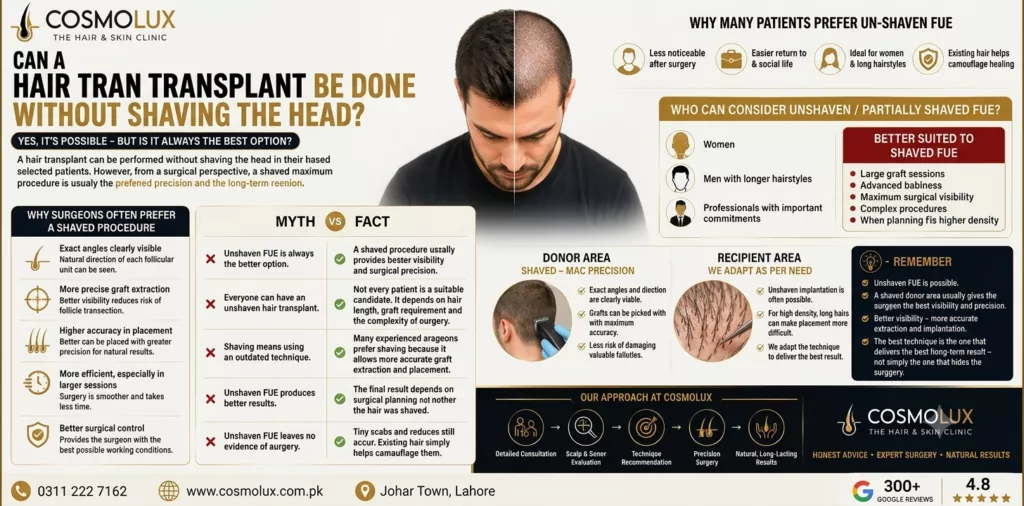
Yes, a hair transplant can be performed without shaving the head in selected patients. However, from a surgical perspective, a shaved procedure is usually the preferred approach.
Why?
Because shaving allows the surgeon to:
- Clearly see the natural angle and direction of every donor hair.
- Harvest follicular units with maximum precision.
- Reduce the risk of damaging follicles during extraction.
- Place grafts more accurately.
- Work more efficiently, especially during larger procedures.
While unshaven FUE is an excellent option for carefully selected patients, it should never compromise surgical precision. The primary goal should always be achieving the best long-term result—not simply avoiding a haircut.
Why Do Many Patients Prefer an Unshaven Hair Transplant?
Many patients worry about returning to work, attending social events, or explaining why they suddenly shaved their head. For this reason, unshaven or partially shaved FUE has become increasingly popular. Existing hair can help camouflage the donor and recipient areas during the early healing period, making the procedure less obvious.
However, cosmetic convenience should always be balanced against surgical accuracy.
Hair Science Simplified
- Think of Repairing a Precision Watch
- Imagine repairing a very fine mechanical watch.
- If every gear is clearly visible, the repair is faster, easier, and more precise.
- If some of the gears are hidden, the repair is still possible—but it becomes more technically demanding and requires extra time and care.
- Hair transplantation follows the same principle.
- When the donor area is shaved, every follicular unit and its natural exit angle are clearly visible. This allows the surgeon to extract grafts with maximum accuracy.
- Long hairs can partially cover these angles, making extraction more technically challenging.
Myth vs Fact
- Myth: A hair transplant without shaving is always the better option.
- Fact: Unshaven FUE is mainly a cosmetic preference. A shaved procedure usually provides better visibility and surgical precision.
- Myth: Everyone can have an unshaven hair transplant.
- Fact: Not every patient is a suitable candidate. The decision depends on hair length, graft requirement, donor characteristics, and the complexity of the surgery.
- Myth: Shaving the head means using an outdated technique.
- Fact: Many experienced hair transplant surgeons prefer shaving because it allows more precise graft extraction and implantation.
- Myth: Unshaven FUE produces better results.
- Fact: The final result depends on surgical planning and technique—not whether the hair was shaved.
CosmoLux Clinical Insight
One of the most common questions we hear is:
“Doctor, can I have a hair transplant without shaving my head?”
Our answer is:
“Yes—but first we ask a different question.”
“Which technique will give you the best surgical result?”
From a surgeon’s perspective, shaving the donor area provides the greatest accuracy. It allows us to clearly identify the natural angle and direction of every follicular unit, helping us harvest grafts with maximum precision while reducing unnecessary follicle injury.
In the recipient area, unshaven implantation is often possible.
However, when creating higher density or working between long existing hairs, those hairs can make graft placement technically more difficult and may reduce surgical efficiency. For this reason, although unshaven FUE is an excellent option for selected patients, our recommendation is always based on achieving the best surgical outcome—not simply avoiding a haircut.
Important Exception
Patients with smaller procedures, longer hairstyles, or important professional commitments may benefit from an unshaven or partially shaved procedure.
In these cases, reduced visible downtime may outweigh the additional technical difficulty.
However, for larger sessions, advanced baldness, or when maximum density is planned, a shaved procedure often allows greater precision, consistency, and efficiency.
Remember This
- Unshaven FUE is possible.
- A shaved donor area usually provides the surgeon with the best visibility.
- Better visibility allows more precise graft extraction.
- Long existing hairs can make dense implantation more technically challenging.
- The best technique is the one that delivers the best long-term result—not simply the one that hides the surgery.
Frequently Asked Questions
Can I have a hair transplant without shaving my head?
Yes. Many patients are suitable candidates for unshaven or partially shaved FUE, depending on their hair length, hairstyle, and the number of grafts required.
Why do many surgeons prefer shaving?
Because shaving allows better visualization of the natural angle and direction of each follicular unit, improving precision during graft harvesting and placement.
Does shaving improve the result?
Shaving itself does not improve hair growth, but it often allows the surgeon to work with greater accuracy, especially during larger or more complex procedures.
Which technique is best?
There is no single answer for every patient.
The best technique is the one that provides the safest surgery, the highest level of precision, and the most natural long-term result for your individual case.
The CosmoLux Perspective
At CosmoLux, we don’t recommend a procedure simply because it is fashionable or easier to market. We recommend the technique that gives you the best chance of achieving a natural, long-lasting result.
If an unshaven procedure is suitable, we are happy to offer it.
If shaving will significantly improve surgical precision and the final outcome, we will explain why and help you make an informed decision. Our priority is always the quality of your result—not the popularity of a technique.