Reading Time: 3 Minutes
Quick Answer
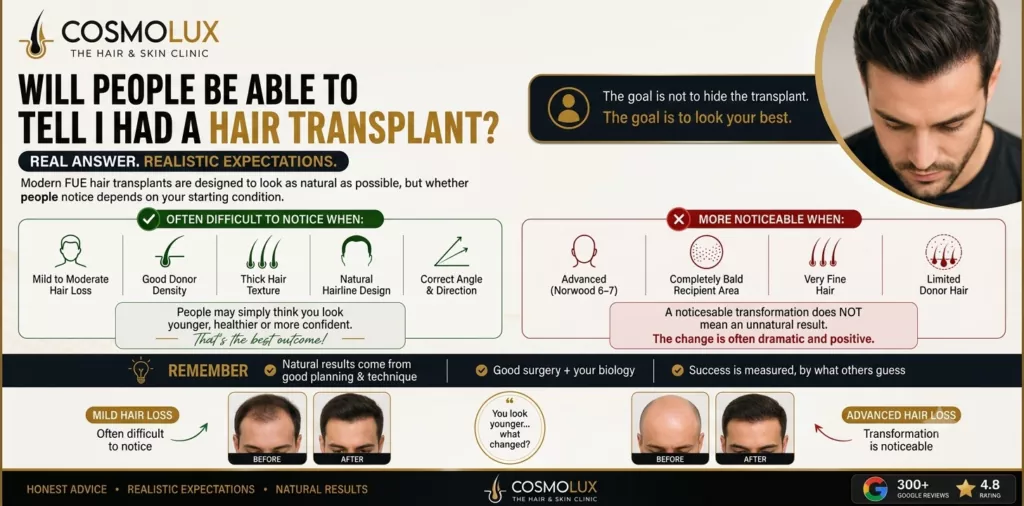
Modern FUE hair transplantation is designed to look as natural as possible, but whether people notice depends on your starting condition—not just the surgery itself. Many patients achieve results that are difficult for others to detect.
However, if you have very fine hair, extensive baldness (Norwood 6–7), a limited donor area, or a completely bald recipient area, people who know you well may realise you’ve had a hair transplant because the change is significant. That doesn’t mean the transplant looks unnatural.
In fact, even when people recognise that hair restoration has been performed, patients usually look younger, healthier, and more confident. The goal is not to hide the transplant at all costs. The goal is to create the most natural-looking improvement possible.
Why Do Some Hair Transplants Look More Natural Than Others?
Years ago, hair transplants often produced the well-known “pluggy” appearance because large grafts were placed in straight rows.
Modern FUE is completely different.
Today’s techniques use naturally occurring follicular units containing one, two, three, or four hairs, allowing surgeons to recreate the natural pattern of hair growth.
However, the final appearance still depends on several important factors:
- Your degree of baldness.
- Donor hair quality and density.
- Hair thickness and colour.
- Hairline design.
- Graft angle and direction.
- Surgical planning and technique.
A successful transplant is the combination of good surgery and favourable biology.
Hair Science Simplified
- Think of Renovating a Garden
- Imagine restoring an old garden.
- If the garden already has healthy plants and you’re simply filling a few empty spaces, the result blends almost seamlessly.
- But if the entire garden is bare, everyone will notice that it has been beautifully restored.
- The same principle applies to hair transplantation.
- Patients with mild hair loss often achieve results that are difficult to detect.
- Patients with advanced baldness may have a more obvious transformation—not because the transplant looks unnatural, but because the improvement is dramatic.
Myth vs Fact
- Myth: A successful hair transplant is one that nobody can ever detect.
- Fact: Many excellent hair transplants are difficult to detect, but patients with extensive baldness or very fine hair may still have noticeable restoration because the change is significant.
- Myth: Everyone gets the same natural-looking result.
- Fact: The final outcome depends on your donor hair, hair characteristics, degree of baldness, and individual healing.
- Myth: A lower and denser hairline always looks better.
- Fact: The most natural hairline is one designed for your age, facial proportions, donor capacity, and future hair loss.
- Myth: A perfectly straight hairline looks ideal.
- Fact: Natural hairlines have soft irregularities that make them look realistic.
CosmoLux Clinical Insight
One of the most common questions we hear is:
- “Will people know I’ve had a hair transplant?”
- Our answer is always honest.
- If your hair loss is mild to moderate and your donor hair is strong, many people may simply think you look younger or healthier without realising why.
- However, if you begin with complete baldness or advanced hair loss, family members, friends, or colleagues may recognise that you’ve had a hair transplant because your appearance has changed so dramatically.
- That is not a failure—it is often a success.
- You have gone from having little or no hair to having a natural-looking hairline and improved coverage.
- Our goal is not to promise perfection.
- Our goal is to use your available donor hair to achieve the most natural, balanced, and aesthetically pleasing result possible.
Important Exception
No surgeon can create unlimited density.
Patients with advanced baldness have fewer donor follicles available to cover a much larger recipient area. In these situations, careful planning becomes even more important. Sometimes a second procedure may be recommended to improve density, while in other cases the available donor hair is best preserved for future needs. Realistic expectations are one of the most important parts of a successful hair transplant journey.
Remember This
- Naturalness depends on both surgical skill and your starting condition.
- Advanced baldness may result in a more noticeable transformation.
- A noticeable improvement is not the same as an unnatural result.
- The best hair transplant is one that looks balanced, age-appropriate, and natural.
Frequently Asked Questions
Can a hair transplant look completely natural?
Yes. Many modern FUE hair transplants look very natural, especially in patients with favourable hair characteristics and good donor density.
Why do some people still notice a hair transplant?
Patients with extensive baldness, very fine hair, or limited donor hair often undergo a dramatic transformation. People may notice the improvement, but that doesn’t mean the transplant looks unnatural.
Does everyone get the same density?
No. Density depends on donor availability, the size of the bald area, and long-term planning.
What is the real goal of a hair transplant?
The goal is not to create perfection.
The goal is to restore hair in the most natural and aesthetically pleasing way possible while respecting the limitations of each patient’s donor hair.
The CosmoLux Perspective
Hair transplantation is not about creating the same result for every patient. Every patient starts with different genetics, hair characteristics, donor capacity, and degree of baldness. Someone with mild hair loss may achieve a result that is almost impossible to detect. Someone with advanced baldness may still be recognised as having undergone hair restoration because the transformation is remarkable.
Success should not be measured by whether someone guesses you’ve had a transplant. Success should be measured by how much your appearance, facial harmony, confidence, and quality of life improve. A natural-looking improvement will always be more valuable than chasing unrealistic perfection.