Reading Time: 4 Minutes
Quick Answer
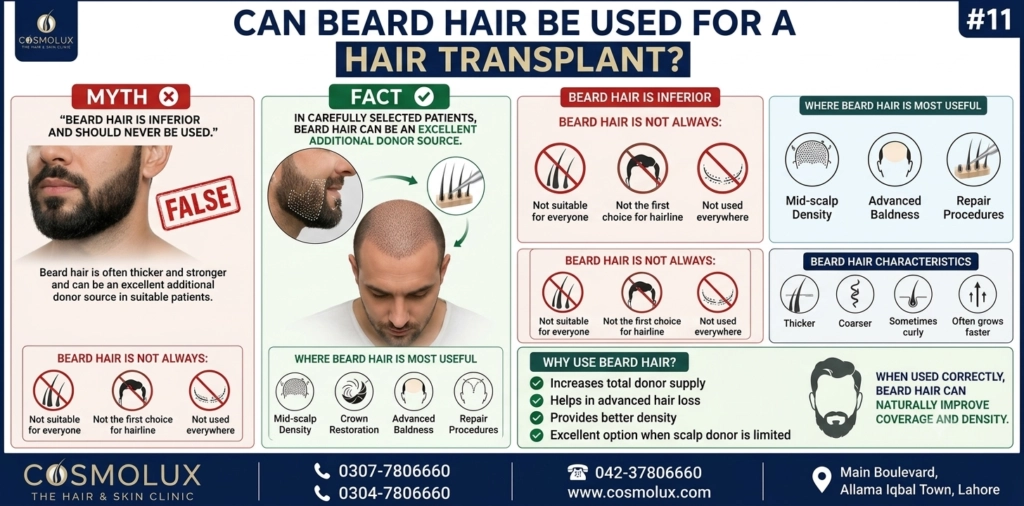
Yes. In carefully selected patients, beard hair can be an excellent additional donor source.
However, beard hair is not a replacement for scalp donor hair.
Whenever possible, the scalp donor area remains the first and best choice because its hair characteristics usually match the scalp more naturally.
Beard hair is mainly used when:
- Scalp donor hair is limited.
- Hair loss is extensive.
- A previous hair transplant has already used many scalp grafts.
- Additional density is required in selected areas.
The Biggest Myth
- Myth: “Beard hair is inferior and should never be used.”
- Fact: Beard hair is often thicker than scalp hair and can provide excellent additional donor grafts in suitable patients.
When used correctly, it can significantly improve coverage and density.
Hair Science Simplified
- Think of Matching Building Materials
- Imagine repairing a house.
- Ideally, you use bricks from the same manufacturer because they match perfectly.
- If you need more bricks, you may use another high-quality source that is slightly different but still strong and durable.
- Hair transplantation works in a similar way.
- Scalp hair usually provides the closest match.
- Beard hair becomes an excellent additional resource when more grafts are required.
Does Beard Hair Look Different?
Yes.
Beard hair is generally:
- Thicker
- Coarser
- Slightly curlier
- Often grows faster
Because of these characteristics, experienced surgeons usually place beard grafts strategically rather than everywhere.
Where Is Beard Hair Most Useful?
Beard hair can be particularly valuable for:
- Mid-scalp density
- Crown restoration
- Advanced baldness
- Repair procedures
- Patients with limited scalp donor reserves
It is usually not the first choice for creating the frontal hairline, where softer scalp hairs generally produce the most natural appearance.
Can Everyone Donate Beard Hair?
No.
Suitability depends on:
- Beard density
- Hair quality
- Skin characteristics
- Overall treatment plan
- Individual goals
Some patients have excellent beard donors.
Others may not.
Does Removing Beard Hair Leave Visible Marks?
When performed properly using modern FUE techniques, tiny extraction sites usually heal very well. Most become difficult to notice after healing. As with any procedure, healing varies from person to person.
CosmoLux Clinical Insight
One of the greatest advantages of modern FUE is donor flexibility. In selected patients, we can safely combine scalp and beard donor hair to increase the total number of available grafts.
However, more donor sources do not mean every patient needs them.
At CosmoLux, we first evaluate your scalp donor area. Only when additional grafts are likely to improve the final result do we consider beard hair. Our goal is always to achieve the most natural appearance while preserving every valuable donor resource.
Remember This
- Scalp donor hair remains the first choice.
- Beard hair can be an excellent additional donor source.
- Not everyone needs beard grafts.
- Beard hair is usually used strategically—not everywhere.
- The treatment plan should always be individualized.
Frequently Asked Questions
Is beard hair permanent after transplantation?
Yes. Like scalp donor hair, beard follicles generally retain their biological characteristics after transplantation.
Can beard hair be used for the hairline?
Usually, finer scalp hairs are preferred for the frontal hairline. Beard hair is more commonly used to increase density behind the hairline or in the crown.
Does beard hair continue growing like a beard?
Yes. Once transplanted, beard follicles retain their own growth characteristics, which is why careful placement is important.
Does taking beard hair damage my beard?
When properly planned and evenly harvested, most patients maintain a natural beard appearance.
The CosmoLux Perspective
Modern FUE has expanded the possibilities of hair restoration. For patients with advanced hair loss, beard hair can provide valuable additional grafts when used thoughtfully and strategically. The key is not simply having more donor hair.
The key is using the right donor hair, in the right place, for the right patient.