Reading Time: 3 Minutes
Quick Answer
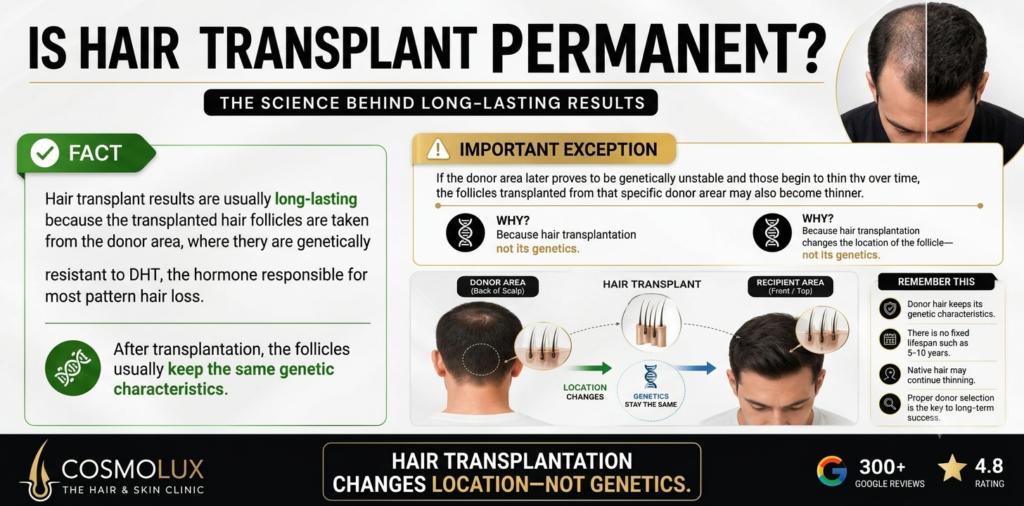
Yes—hair transplantation is usually a long-lasting or lifelong solution because the transplanted hair follicles are taken from the donor area, where they are genetically resistant to DHT (the hormone responsible for most pattern hair loss).
When these follicles are moved to the balding area, they usually retain the same genetic characteristics. In simple words, hair transplantation changes the location of the follicle—not its genetics.
However, there is one important exception.
If the donor area later proves to be genetically unstable and those donor hairs begin to miniaturize over time, the follicles transplanted from that specific donor area may also become thinner, because they continue to behave according to their original genetics.
This is why selecting a stable donor area is one of the most important parts of a successful hair transplant.
Why Do People Believe Hair Transplants Last Only 5–10 Years?
Many people think hair transplants have an expiry date because they see patients whose hair appears thinner several years after surgery.
In reality, this usually happens because:
- The patient’s original (non-transplanted) hair continued to thin due to ongoing genetic hair loss.
- The person expected one surgery to stop future hair loss completely.
- In a small number of patients, the harvested donor hair itself was not completely stable.
The transplant itself does not “expire.”
Hair Science Simplified
- Think of a Mango Tree
- Imagine moving a healthy mango tree from one field to another.
- The tree continues producing mangoes because its genetics have not changed—only its location has.
- Hair follicles behave in the same way.
- A follicle taken from a genetically DHT-resistant donor area usually keeps those characteristics after transplantation.
- Likewise, if a follicle was genetically destined to thin in the future, it will continue to behave the same way even after being transplanted.
- Hair transplantation changes the location—not the genetics—of the follicle.
Myth vs Fact
- Myth: Hair transplants only last 5–10 years.
- Fact: There is no biological expiry date for transplanted hair follicles.
- Myth: Moving a hair follicle changes its strength.
- Fact: The follicle keeps the genetic characteristics of the donor area.
- Myth: If hair becomes thinner years later, the transplant has failed.
- Fact: In most cases, the surrounding native hair has continued to thin. Less commonly, follicles taken from a donor area that later proves genetically unstable may also miniaturize.
- Myth: One hair transplant stops all future hair loss.
- Fact: A hair transplant restores lost hair but does not stop ongoing genetic thinning of your remaining natural hair.
CosmoLux Clinical Insight
One of the most common questions patients ask is:
“Doctor, will my transplanted hair disappear after a few years?”
The answer is usually no.
When donor hair is selected correctly from a stable donor area, transplanted follicles generally continue growing for many years because they retain their natural resistance to DHT.
However, we also explain that a hair transplant does not prevent future thinning of the patient’s existing native hair. In some individuals, medical treatment or an additional procedure may be recommended later to maintain overall density.
Important Exception
Hair transplantation depends on choosing the right donor area. If follicles are harvested from a region that later proves genetically unstable and those hairs begin to miniaturize, the transplanted follicles taken from that region may also thin over time.
This is not because transplantation weakened the hair. It is because the follicle retained the same genetic behaviour it had before it was moved. Proper donor assessment is therefore one of the most important factors in achieving durable, natural-looking results.
Remember This
- Hair transplants are generally designed to provide long-lasting results.
- Donor hair is usually genetically resistant to DHT.
- Hair transplantation changes the location of a follicle—not its genetics.
- Native hair may continue thinning even after a successful transplant.
- Careful donor selection is essential for long-term success.
Frequently Asked Questions
Can transplanted hair fall out after surgery?
Yes. Temporary shedding (shock loss) during the first few weeks is normal. The follicles usually remain alive and begin producing new hair over the following months.
Will I ever need another hair transplant?
Not always. Some patients never require another procedure, while others choose a second session because their natural hair continues to thin with age.
Can transplanted hair turn grey?
Yes. Transplanted hair ages naturally and can become grey just like the hair in the donor area.
Can transplanted hair be cut, coloured, or styled?
Yes. Once healing is complete, transplanted hair behaves like normal hair and can be washed, cut, coloured, and styled.
The CosmoLux Perspective
A hair transplant is hair redistribution—not the creation of new hair. When performed on the right patient using a stable donor area, the results are generally long-lasting and natural. Our goal is not simply to restore today’s hairline, but to create a result that continues to look natural for many years.